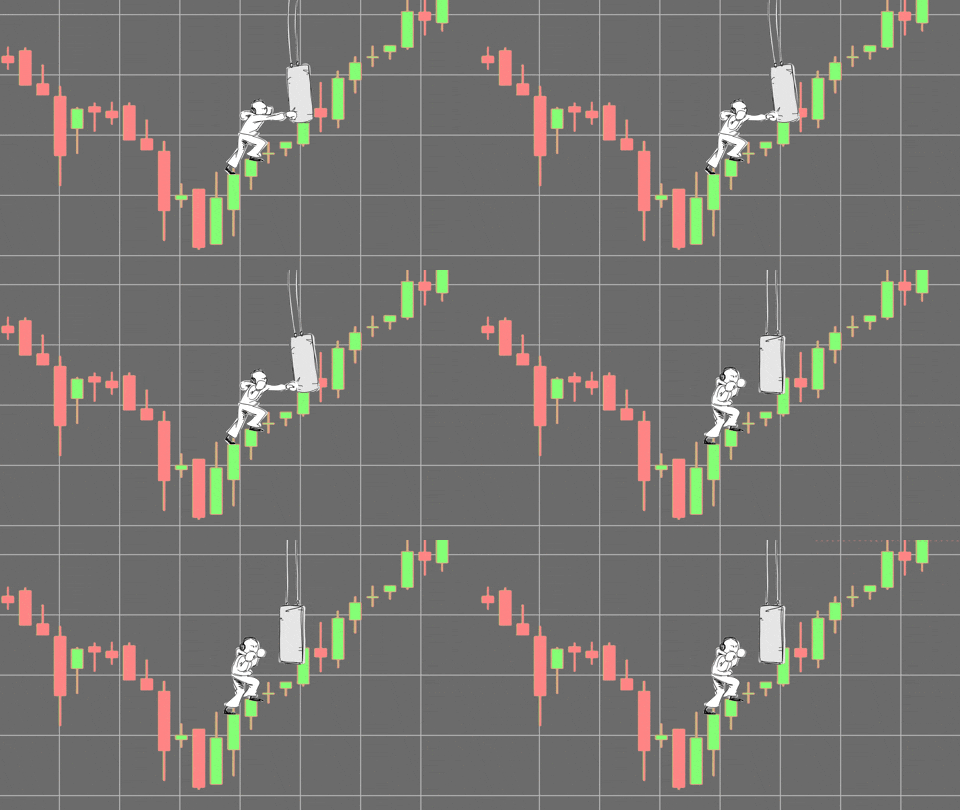
cause and effect

So, what is the AI bubble? What actually caused RAM prices to skyrocket? Well, the AI bubble is currently a theory that AI is being overly invested in, which could cause it to pop at any moment (causing the stock price/its value to critically drop).

The reason for these skyrocketing RAM prices, though, is AI datacenters.

A few of these companies realized they could make billions of dollars in profit by just making RAM for AI data centers instead of supplying the rest of the market. So the companies that produce RAM started shutting down the consumer memory lines and started devoting all of their resources to AI. AI Datacenters are the sole negative factors in making PC Hardware shoot up exponentially in price, and will make it significantly more difficult to buy a personal computer within a budget, or a personal computer meant for gaming in 2026.

The effects of this is catostrophic.

RAM prices have shot up from 30$ to 120$ for DDR4, and 150$ to 500$ for 64 gigs of DDR5. Prices for DDR5 have gone up 178% - 258%, which is an insane percentage to even just look at. Due to these prices, the first crowd to be impacted would have to be the PC builders, and sooner or later, everything else with memory in it will be hit, cameras, consoles, tablets, and the device you’re viewing this on.
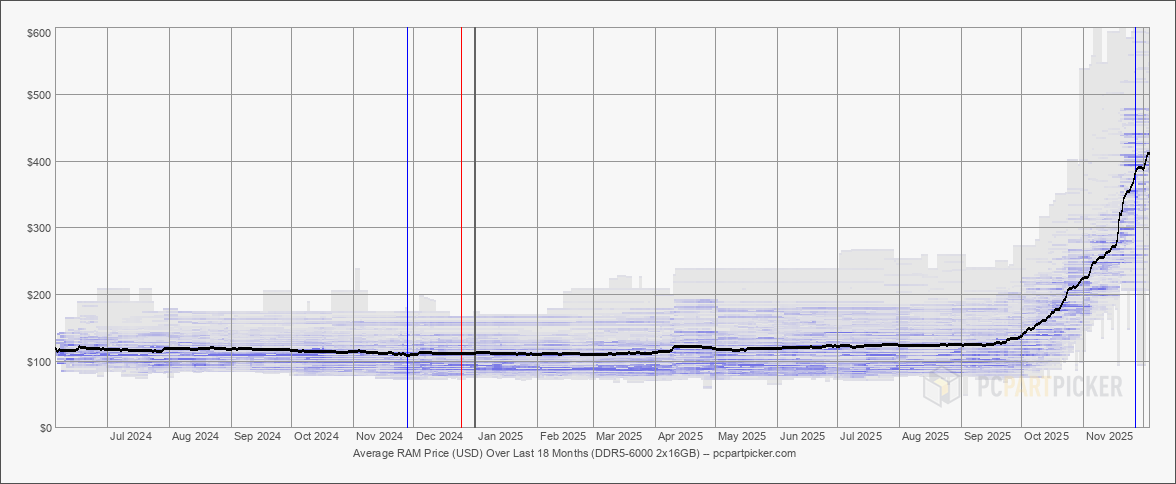
RAM prices chart DDR5-6000 2x16GB

Even companies like Lenovo are stockpiling on RAM because of the insane price; companies like Raspberry Pi raised prices for something that was considered cheap. Samsung is even struggling to buy its own RAM from its sibling sub-company because they have been completely contracted by AI datacenters.

The problem here is that prices were so low months ago that there was no need to have a pile of RAM in stock; as such, when demand increased heavily for the AI datacenters, there was not enough supply to meet the demand for the pc building market. therefore the consequences of this event folded out in the past 8 months.

Effect amplified x2

As I’ve mentioned before, RAM isn’t the only price tag that will be affected in 2026; it will affect everything with RAM. But it would mostly affect the pc hardware industry, it will affect other pc hardware like GPUs, and Storage (HDD, SDD). NAND flash memory used in SSD storage is a part of the RAM price spike, and because AI datacenters are using up NAND production for the servers inside the datacenters, it could take away production resources for consumer SSDs after supply becomes limited.

actually this is already happening, HDDs from Western Digital raised their prices for all of its HDD products, and the popular pc article “pc gamer” received a comment that states “...cold data storage has gradually shifted toward SSDs, further tightening NAND Flash supply.” meaning that it’s possible that in the near future SSD prices will start rising due to the shortage of memory.

But what about GPU prices? Don’t they seem quite far away to be affected?

well they’ll be affected as well. Although GPUs may seem far away right now, there's already chatter about graphics cards being affected in the future by this insane price hike. As demand increases in the AI bubble for memory its more likely that the few companies that make memory will divert production from GPU memory supplies to AI memory supplies.

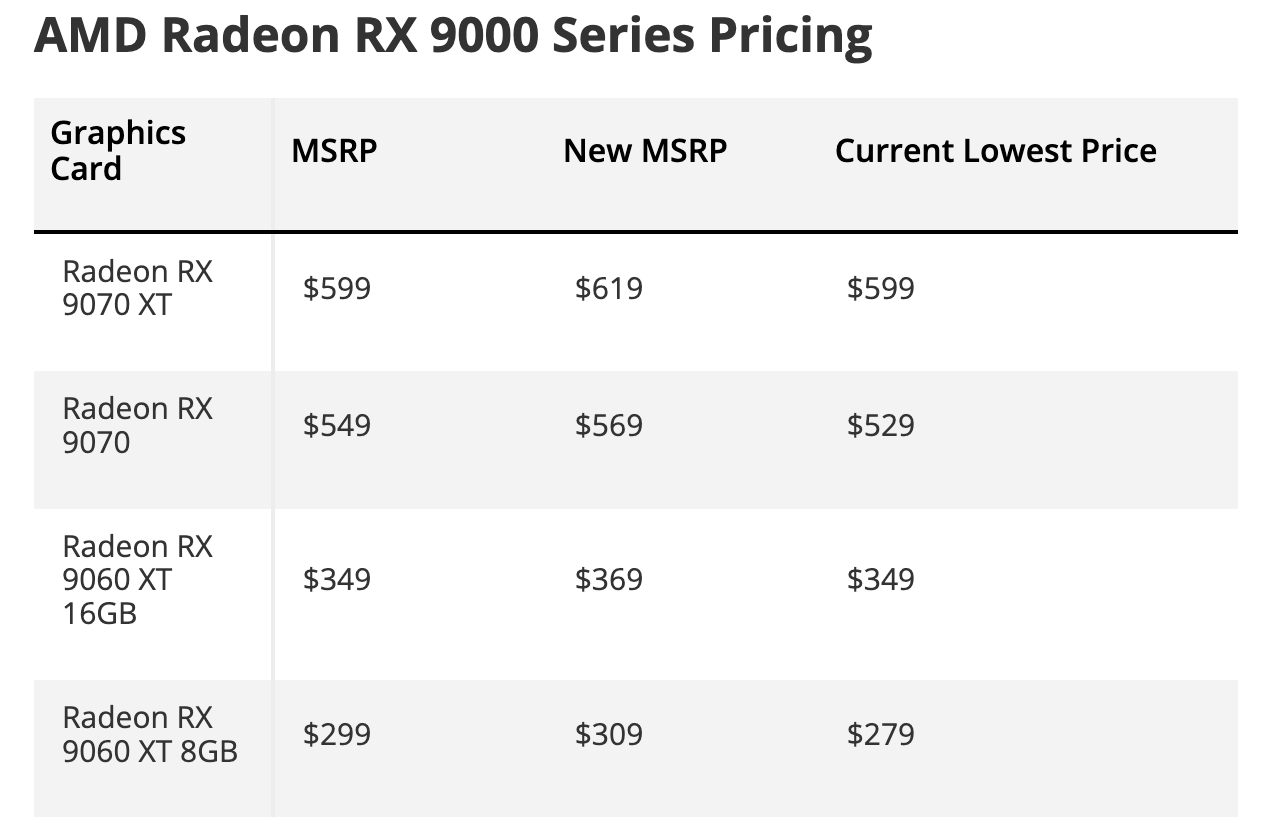
As such, supply begins to drop, and GPU memory prices go up. GPU prices are already being affected though, with AMD raising prices on the Radeon RX 9000 series GPU 10$ every 8 gigabytes.

Along with AMD increasing prices for their GPU, Nvidia absolutely shut down supplying any VRAM to their GPU board partners, leaving their partners to fend for themselves and search for other VRAM sources, causing a tighter supply, leading to you know what... a GPU price increase!

Now, I took the liberty to research more into it, and there’s more than just pc hardware being affected. With RAM being scarce now, it could lead to phones and laptops raising their prices, budget phones could stop being budget phones, and increase in price by 10% in 2026. Laptops are more at risk of a price increase since memory/storage usually takes 10% -18% of the cost of a Laptop it’ll push the total beyond 20% of the original price, affecting the mainstream tech consumer industry.

Besides budget phones and laptops, even pc accessories like monitors could be affected, with people buying less pc’s, it could mean that the accessories connected to a pc would get less sells.

AAAND CUT.

Unfortunately for us, RAM inflation driven by AI data centers is likely to continue beyond 2026, placing significant difficulty on PC builders and consumers seeking to purchase new hardware. The resulting price hikes from RAM threaten the PC hardware industry, causing personal computers to be heavily affected in 2026, which then causes people who want to buy a pc to be unable to afford it due to the insane price increase in buying all parts together.

While the full impact of these RAM price hikes is still unfolding, the evidence shown in this research highlights the widespread effects that range from skyrocketing RAM and storage prices to ripple effects on GPUs, phones, and laptops. Major GPU producers like AMD and Nvidia have already adjusted their strategies in response to memory shortages, further increasing consumer costs. This situation shows the powerful chokehold AI data centers now have over the personal computer market, as every big RAM producer shifts production away from consumer needs to meet data center demand. But then what would happen if the AI bubble popped?

Although some speculate that a burst of the AI bubble could flood the market with cheaper hardware, the reality is that the specialized memory used in AI RAM differs from what personal computers require, minimizing any potential benefit to consumers. As such, we wouldn’t have a silver lining after such a struggling event like this one, but the question is still out there: what would be the widespread effect of the AI bubble popping or what would happen if it doesn't pop?

Ultimately, this research project has provided insight into the causes and consequences of these shifts, deepening our understanding of how consumers and the broader industry are being reshaped by the growing dominance of AI data centers.

go back to title screen?